
Connecting expertise. Sharing capacity. Supporting better care.
Share radiology expertise and capacity across hospitals
HubNex matches imaging studies with radiologists based on availability and specialisation, enabling collaboration across hospitals. It integrates with existing radiology systems so radiologists can keep working with familiar tools, without requiring hospitals to replace their systems.


Expertise and capacity aren't always where they're needed.
When workloads peak or a study calls for specialist expertise, hospitals should be able to draw on the expertise and capacity available within their collaboration network. HubNex helps coordinate that collaboration through existing radiology systems.
Connecting expertise.
Help hospitals access relevant radiology expertise by matching studies with radiologists based on specialisation and availability within their agreed collaboration network.
Sharing capacity.
Help hospitals share available reporting capacity and coordinate support when workloads change, making better use of the people and resources already available.
Supporting better care.
Aim to shorten reporting turnaround times so referring clinicians have the information they need sooner to support patient care decisions.
The Growing Crisis
Why now: reporting capacity is under pressure
Radiology teams across Europe face growing pressure: an ageing workforce and rising demand are straining reporting capacity.
"16 of 27 EU member states fall below the average of 127 radiologists per million. 45% of Europe's radiologists are over 51, with 19% set to retire within five years — yet imaging demand is projected to surge 70% by 2030."
"The UK faces a 29% shortfall in radiology consultants, projected to reach 39% by 2029. CT and MRI demand grew 8% in 2024 while the workforce grew only 4.2% — the gap is widening every year."
"In 2024, 976,000 imaging scans in England breached the one-month reporting target — a 28% increase year-on-year."
Sources: EU-REST / European Commission Census · PubMed Central (PMC) · Royal College of Radiologists 2024 Workforce Census · NHS England Diagnostic Data. European and UK figures are shown as context, not as Belgian-specific measurements.
Your Workflow, Unchanged
HubNex is designed to operate alongside your existing systems. Studies arrive in the workflow you already use, and finished reports return through the agreed route.
Illustrative interface with fictional data.
Study lands on your worklist
A partner hospital in your agreed collaboration sends a study request. It arrives in the workflow you already use, prioritised and labelled. No VPN or inbound firewall rules are needed.
Prior exams pre-attached
Relevant prior studies can be matched to the request, so the reading radiologist has context. Matching depends on the data each site shares.
Clinical context alongside the study
Where a hospital has configured it, age band, gender, order priority and a coded indication arrive with the study. Names and dates of birth are not shared.
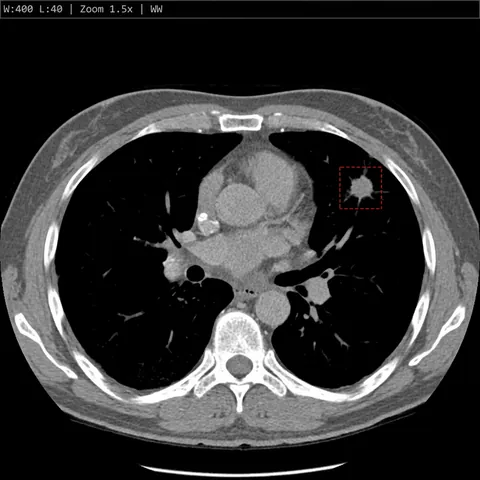
Read in your own PACS viewer
Open the study in the same viewer you use every day. No retraining. No new hanging protocols to configure. Subspecialty routing means you only see cases matched to your expertise.
The report returns to the requesting team
Finalise the report as normal. HubNex routes it back to the requesting hospital through the agreed workflow, with an audit trail.
How HubNex helps hospitals
work together
A vendor-neutral platform designed to support collaboration across hospitals and more timely reporting.


 Dr. Maes is typing…
Collaboration Across Hospitals
Share studies and discuss cases across the hospitals in your agreed collaboration network, through your existing PACS. Second reads and joint review stay alongside the study, visible only to the institutions involved.
- Standards-based DICOM and HL7 connectivity
- Relevant prior studies matched to each request
- Case discussion attached to the study, with audit trail
- Second-read requests between facilities

Neuroradiology · Hospital B
MSK · Hospital C

Chest Radiology · Hospital D
Expertise & Capacity
When local capacity runs thin, you can draw on subspecialists elsewhere in your agreed collaboration network for second reads, urgent cases or overflow reporting. Cases are distributed by subspecialty, urgency and capacity, to support more timely reporting.
- Subspecialty credentials and expiry tracked
- Participation governed by agreements between sites
- Routing by subspecialty and urgency
- SLA warnings before deadlines are missed
Received
Priority: High
Dr. Maes
Finalised
Routing & Escalation
Define the rules once. HubNex prioritises, routes and escalates studies according to your configuration, and tracks critical findings until they are acknowledged.
- Rule-based routing by modality, urgency and subspecialty
- Urgency tiers: standard, priority, urgent
- SLA timers with pre-breach warnings and escalation
- Critical findings: in-app notification, acknowledgement and escalation
- Full routing decision log
Works With Your Systems
HubNex connects to your existing PACS and RIS rather than replacing them. The Edge Agent runs inside your network and opens outbound HTTPS connections only, so no inbound firewall rules or VPN are needed. Scope, configuration and responsibilities are agreed with each hospital during onboarding.
- Standards-based DICOM and HL7 interfaces; compatibility is confirmed per site
- Zero inbound ports · outbound HTTPS only
- Edge Agent authenticated with mutual TLS certificates
- Security white paper and Q&A pack available for your security review
Security & Data Protection
Designed for healthcare data: encryption in transit and at rest, role-based access, multi-factor authentication for administrators and append-only audit logs. ISO 27001 and SOC 2 are on our roadmap and not yet achieved.
- Encrypted in transit and at rest, hosted in the EU
- Role-based access & full audit trail
- GDPR data processing agreement and DPIA support pack available
What it means for each team
- Hospital management
- Access to expertise and shared capacity, with your existing systems retained.
- Radiology leaders
- Coordinate support across hospitals as workloads change, within the participation and allocation rules your hospitals agree.
- Radiologists
- Studies matched to your expertise and availability, worked on in the tools you already use.
- Hospital IT
- Connect existing PACS, RIS and reporting environments through standard interfaces.
- PACS and RIS partners
- Support collaboration around existing systems, with clear interfaces and responsibilities.
- Referrers and patients
- The aim is more timely reports, to support care decisions.
Routing that understands radiology
Not every study is the same. HubNex weighs urgency, modality, subspecialty and contract terms when it dispatches a study.
Prior-Study Matching
When a study is routed for reading, HubNex can match relevant prior exams so the radiologist has context in their own workflow.
- Matching by pseudonymised patient reference
- Relevant priors forwarded with the current study
- Context available in the reading workflow
- Depends on the data each site shares
STAT Priority Routing
Urgent studies are prioritised and tracked against SLA timers. If a study is not picked up in time, HubNex escalates it according to the configured rules.
- Urgency extracted from HL7 ORC/OBR priority field
- Routing to available readers by specialty and contract
- SLA timers with pre-breach warnings and escalation
- Full routing decision log
Contract-Aware Routing
HubNex checks routing rules at dispatch. A study only goes to a site that is covered by an agreement and matches the configured criteria.
- Contract-aware: studies only go where agreements allow
- Per-country cross-border routing controls
- Modality-specific site capability checks
- Configurable rule sets per institution or network
From a collaboration request to a report.
A participating hospital requests support, HubNex matches the study with relevant available expertise at another hospital, and the report returns through the agreed workflow.
Initiate
A participating hospital submits a study for support within an agreed collaboration.
Match
HubNex coordinates the request using relevant specialisation, availability and configured collaboration rules.
Review and report
The receiving radiologist reviews the study and prepares the report in the supported working environment.
Return and follow up
The report returns to the requesting team for the agreed clinical handling and follow-up.
Start with a conversation.
Join our pilot programme or talk to our team to learn more.
Frequently asked questions
Everything you need to know about integrating HubNex into your radiology network.
Still have questions?
Talk to our team →Overview
3 questionsHubNex is a cloud-edge platform that connects hospitals' PACS/RIS systems so they can share radiology expertise and capacity. Studies are matched to radiologists by availability and subspecialty. It is for hospitals, radiology departments and imaging centres, and it is currently in a pilot phase.
HubNex is a technology platform, not a reading service. Participating hospitals agree the terms of their collaboration; HubNex coordinates routing, tracking and audit. How reporting responsibilities are shared between hospitals depends on the agreement and the regulations that apply in each country.
No. HubNex works alongside your existing PACS/RIS through an on-premise Edge Agent and standard DICOM/HL7 interfaces. System replacement is not required; configuration and responsibilities are agreed during onboarding.
Technical
4 questionsDeploy the lightweight Edge Agent inside your network. It connects to your PACS/RIS via DICOM/HL7 and communicates with the HubNex cloud through outbound connections only. No PACS replacement is needed. Prerequisites and timeline are agreed during onboarding.
HubNex uses standard DICOM and HL7 interfaces, and compatibility is confirmed with each site's PACS/RIS during onboarding. If connectivity is lost, the edge agent keeps studies in an encrypted buffer and forwards them when the connection returns.
HubNex uses a hybrid cloud-edge architecture. The Edge Agent runs inside your network and handles DICOM/HL7 communication with your PACS/RIS. Studies shared for reading are transferred to the HubNex platform, which is hosted in the EU (Germany or Finland during the pilot), encrypted in transit and at rest, and deleted within 30 days of the end of the pilot. Other deployment options can be discussed with our team.
Timelines are agreed per site during onboarding. They depend on your PACS/RIS configuration, network approvals and security review, and our team supports each pilot site through setup.
Compliance
4 questionsHubNex is designed around GDPR. A data processing agreement (Art. 28) and a DPIA support package are available, data is hosted in the EU, encrypted in transit (TLS 1.3) and at rest, access is role-based, administrators use multi-factor authentication, and actions are recorded in append-only audit logs. HIPAA is a US requirement and is not part of our current European pilot.
Access to the platform is role-based, and administrators must use multi-factor authentication. In the pilot, each hospital manages its own clinical users within its existing PACS and identity systems. Actions are recorded in append-only, timestamped audit logs.
Studies shared for reading are sent from the sending hospital's Edge Agent to the HubNex platform, hosted with an EU provider (Germany or Finland during the pilot). They are encrypted, and retained only for the pilot period plus up to 30 days. Clinical context from a hospital is reduced to an age band, gender, priority and coded indication before it leaves the hospital. A GDPR data processing agreement is available.
ISO 27001 certification is a target for HubNex and has not yet been achieved; our hosting providers hold their own ISO 27001 certificates. We are working towards NIS2 readiness. A security white paper and security Q&A pack are available on request.
Workflow
4 questionsRouting rules let you prioritise by modality, subspecialty, urgency and contract terms. Cases are matched to available radiologists within your agreed network, and escalate if they are not picked up in time.
HubNex is designed so radiologists keep using their familiar viewers and reporting tools. Some roles, such as site administrators, use the HubNex web application for configuration and monitoring. Workflow impact is assessed with each site during onboarding.
HubNex routing is rule-based (modality, urgency, subspecialty). HubNex coordinates routing and does not perform diagnostic analysis, and integration of external AI tools is not part of the current offering.
In the pilot, referring clinicians work through their own hospital's systems, where the returned report arrives. Direct access for referrers may be offered in a later phase.
Admin & Analytics
3 questionsDashboards show study flow, turnaround times, SLA status and workload distribution. Reporting and export options can be discussed during onboarding.
Support and service levels for the pilot are set out in the pilot agreement. Contact us to discuss what your hospital needs.
Pilot terms are set out in the pilot agreement, and post-pilot pricing depends on study volume and the services you use. Contact us for details.
Contact Us
Explore what radiology collaboration could mean for your hospital.
Tell us how your hospital organises radiology today, where sharing expertise or capacity could help, and which systems you use.
Location
Gent, Belgium
Phone
(+32) 486 036 288
(+32) 484 367 188
contact@HubNex.net
Location
Gent, Belgium
Phone
(+32) 486 036 288
(+32) 484 367 188
contact@HubNex.net